
Akhenaten
Mesopotamia, Pharaohs, Moses
Idealizing God did not begin with Moses or Abraham. The human impulse toward the Divine is older than scripture, older than covenant, older than name.
Long before the revelations associated with Moses or Abraham, humanity was already reaching upward.
In ancient Mesopotamia, between the Tigris River and the Euphrates River, early city-states lifted temples toward the sky. The heavens, rivers, storms, and harvests were deified. Names were given to Anu, Enlil, and Inanna, each an attempt to interpret the forces that governed life.
These were not errors so much as early articulations. Human consciousness was awakening, but still reading the Divine through fear of flood, famine, and sky.
Temples rose. Ziggurats towered. Rituals formed.
Yet beneath every altar, beneath every carved symbol, something deeper moved.
The single Light had always been present, not fragmented into many gods, but refracted through the human mind’s early capacity to understand. The Divine was never absent. It was being interpreted according to the bandwidth available.
Every human being has the chance to go beyond this world to God. Our depth is deciding that journey.
What later generations would call the Christ-Light did not begin in Bethlehem. It moved silently through every civilization, beneath every structure, beneath every priesthood. It was not confined to Israel, nor delayed until doctrine matured.
It waited not for geography to change, but for consciousness to deepen.
Moses did not invent monotheism; he articulated a refinement already stirring within humanity. The Pharaohs did not oppose God as rivals; they represented consciousness still identifying divinity with power and throne.
History is not the story of God arriving. It is the story of human awareness gradually clarifying.
The Light has been guiding since the first human breath.
What changed was not God.
What changed was perception.
Monothestic Light in Polytheistic Thinking
Egypt advanced the pattern of polytheistic living with a theocratic society. Pharaohs claimed divinity, and more than two thousand gods filled the pantheon. Entire cities pledged themselves to one deity, practicing henotheism long before monotheism had a name. In that swirl of gold and ritual, young Moses floated on the Nile, rescued into royal privilege and steeped in polytheistic lore. His life reminds us that God’s call often begins in the heart of illusion.
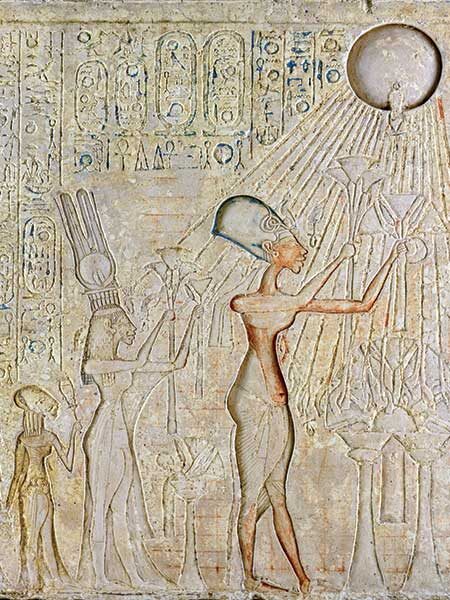
Centuries before Moses, Pharaoh Akhenaten glimpsed something singular. He exalted Aten, the sun disk, as the one god and tried to reorder Egypt around that idea. His vision faltered under political weight, yet it foreshadowed a truth: the Soul is restless until it knows God.
We’re making money a second God and shaping lower mind ideas by it.
When God spoke from the burning bush, Moses stepped from a polytheistic idea of many gods to the One God. That moment was less a theological shift than a leap of consciousness. He discovered that the Creator of stars also speaks within the silence of an exiled shepherd. From Mesopotamian myths to Egyptian pantheons, humanity had been circling the same mountain; the bush simply caught fire to show the path upward.
History reveals a pattern: we search for God through systems, then God breaks the system to meet the individual. Christ’s light has always preceded religion, and it will always carry the door to God. Whether under Babylonian sky, Egyptian sun, or desert flame, the lesson endures: God moves first, we awaken second. Our task is not to protect old temples, but to follow the light that outshines them.
Buddha carried enlightenment drawn from Christ‑light, walking toward God without knowing the name. He lived roughly eight hundred years before Moses, yet the same light guided his awakening. Enlightenment does not originate in ritual; it is the gift of God moving silently within every era. The more we live for mainstream concepts, the further from God we go. We won’t build muscle for God as long as we build muscle for matters level and its ideologies.
His life confirms that divine light precedes belief. We may not recognize God, but His illumination remains the source of every genuine insight. Whether cloaked in royal silk or desert wool, the Soul awakens when inner light outweighs outer comfort. That awakening is always God’s work, quiet, persistent, and universal.
Our knowing God was made to be a religious endeavor, when it has always been the birth cycle of human life. The individual is living to know God regardless of their beliefs, ideologies, and ideas of reality. The mind is a temporal storyteller while the Soul is our light in God.
Knowing God
Only the individual can know God. He doesn’t walk in a group idealogy because, by creation, only one level of consciousness is knowing the world. There’s only one of us here with God, carving depth. The path is by the Soul’s light, ready to know Him. No religion can pave the walk with God. The world already has our personal curriculum with Him.
The Pharaoh Akhenaten lived during a period when polytheistic ideas were prevalent. He faced down the Amun priesthood, traditional cults in Egypt, and a nation long nurtured on a pantheon of gods numbering by the thousands. Ahkenaten’s idiosyncratic idea of God is what every human being lives by.
Siddhartha Gautama walked his path, and Akhenaten his. Muhammed walked his light towards the Angel giving revelations. No one can determine another human being’s walk to God. It is solely between God and them. Nothing in this world breaks bread with God until He chooses it.
Empires and rulers have made religion everything they are today. Nationalism is aligned with periods of war. In the Byzantine and Persian Empires, a ruler wanted to be seen as a god. A theocratic way of living for rulers was normal. Even back when Buddha was living, kingdoms held court with Brahmans.
We have always depended on satan for power and control, or to feel holy.
Beyond this world is our anchor, and without a deeper calling, our depth will not depart the shores of satan. The mind won’t build bridges; it can’t determine the outcome with, and yet that is the hidden door to everything in life. The silent partner carries us and never walks alone.