
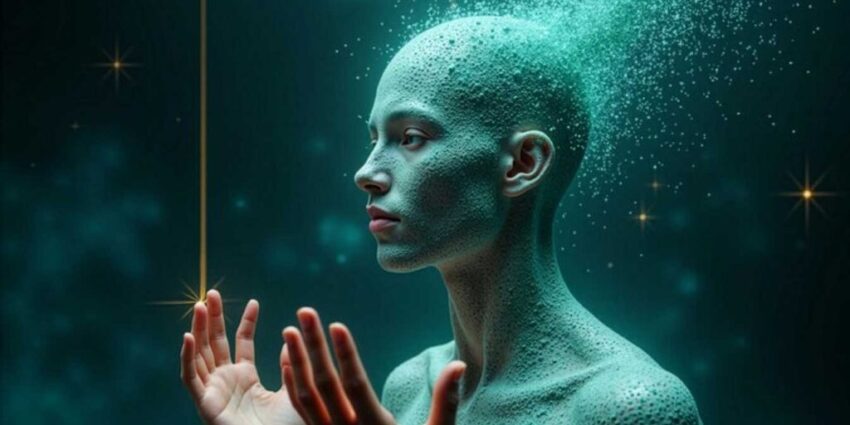
Hear an Angel Speak
Here is an Angel telling us “You Are Him.” Referring to God.
The self is an idea shaped by our present level of consciousness. It is not what we are. What we call “self” is a construct formed by identifying with the body and its story, mistaking form for being.
We are not our thoughts. We do not originate thought in isolation. We move inside a vast pool of consciousness that extends beyond personal memory and culture. Ideas arrive through this field, bearing signatures of intelligences older and wider than our own. Being created means we are blended with other races of intelligence that carry light for us to realize. Recognizing this shared stream does not diminish individuality; it situates us within God’s larger compass.
Tapestry of Self
The tapestry of self is far greater than the ideas we carry about who we are.
When we look into a mirror, we see a face. We recognize features, age, expression, and a body we have learned to call ourselves. Yet even the physical being standing before the mirror is vastly more than the image being reflected.
We do not see the microorganisms living upon and within us. We do not see blood moving through thousands of miles of vessels. We do not see cells communicating, neurons firing, the immune system discerning, organs regulating, tissue repairing, or the countless processes quietly cooperating to sustain what appears in the mirror as one person.
The image is real, but it is not the whole reality.
And still, all of that unseen biology belongs to the measurable world. We can place cells beneath microscopes, map neural activity, study bacteria, examine DNA, and continue moving beneath appearances into increasingly subtle layers of matter.
Spirit is not simply the next object waiting beneath a stronger microscope. That is where the human mind reaches an extraordinary threshold. We are accustomed to believing that if something is real, eventually we should be able to turn it into an object of perception. We want to see it, locate it, measure it, name it, and establish its existence through the senses or instruments extending the senses.
The deepest order of life is not an object within creation. Spirit belongs to the living depth through which creation is being carried. We cannot idealize Spirit from the appearance of things. We cannot look deeply enough into matter and expect God to become another piece of matter hidden underneath it.
The visible human being is more like the outermost thread of an immense tapestry. Personality is one thread. Memory is another. The body, ancestry, biology, relationships, language, culture, and experience are woven through what we presently call self. Yet beneath all the meanings through which we construct identity is the extraordinary fact that something is alive.
Before I decided who I was, I was living. Before I understood the body, it was carrying me. Before I formed an idea of God, existence had already been given.
This changes the question of self. Instead of asking only, “Who do I think I am?” we can begin asking, “What is this livingness in which the individual idea I call myself has appeared?” The answer may not arrive as another idea.
The mind wants to turn even Spirit into meaning because meaning is how it holds things. But Spirit may ask something different of consciousness: not that we conceptualize what lies beneath all things, but that we become quiet enough to recognize that the surface has never explained the depth.
We see the face in the mirror. We do not see everything carrying the face. We experience the thoughts and meanings through which we have assembled a self. We do not see the entire order carrying consciousness.
And we speak of God while living inside a creation whose deepest movements were never ours to command. The tapestry becomes more beautiful when we stop mistaking the thread we can see for the whole of what we are.
There is the visible life. There is the invisible order carrying life. And there is the interior Light through which we begin to recognize that existence reaches far beneath the person we learned to call ourselves.
Conscious energy does not arise from the body; it moves within it. The body is not identity, but a vessel like a garment we put on for a season of experience and then lay aside. What we are wears the body; it is not contained by it.
Each life offers a new suit of form, appropriate to a particular level of consciousness. The clothing changes, the story changes, but the conscious presence remains. When the garment is released, nothing essential is lost. Only the illusion of self dissolves.
What continues is not the body, not the name, not the narrative, but the living awareness that moved through them all along.
When we leave the body, every idea we had of who we think we are, who our family is, and reality fades. God is our mother, father, brother, and sister. Everything is created in a season, not life. Nothing here will live again. The story never exists again, but our living in another one does.
We are the conscious energy inside the body, the eternal light that moves through lifetimes, continuously evolving deeper in God. When we leave this body, we don’t die, we transform, entering new expressions of consciousness. There is no birth or death, only a continuation of consciousness.
We are not here to live as somebody. The ideas we hold about who and what we are belong only to this present level of consciousness. As consciousness deepens and moves toward light, those ideas loosen and change. Identity is provisional; being is not. Thinking is provisional, while consciousness is the Soul’s light in Heaven, giving Spirit the way to live in matter.
God is of no form and of all form and has existed for hundreds of billions of years alive in another light entirely different than ours. From His light human consciousness unfolds into experience, taking shape where it can be lived and releasing shape when it is time to move into new life.
The human being itself is not what is real; consciousness is. What we call consequence, debt, or payment is a construct of the mind trying to explain experience through limitation rather than depth.
The mind’s eye only sees as far as depth allows. It interprets life through surface causality, mistaking pattern for consequence and sequence for judgment. But consciousness does not operate through transaction. It does not keep accounts. It unfolds.
The idea that a human being, created into existence, must pay to live arises from a consciousness still asleep to life itself. That idea does not belong to light. It belongs to fear, attempting to make sense of mystery.
What appears as consequence is not retribution, but movement. What appears as suffering is not owed, but depth-seeking awareness. Consciousness is not correcting itself; it is revealing itself through experience.
Life is not a ledger.
It is an opening.
And as depth increases, the need for explanation through debt dissolves, replaced by understanding, compassion, and light.
The way we gain a deeper understanding of the concept of life is to think beyond the conventional notions of life. Reality has been made by others and not for the individual to know more. We rely on markers that someone else has placed to guide our thoughts, thereby shaping our lives. We’re traveling towards Truth, and depth is the key to the door.
Everything here is a temporal story and sits at one level of consciousness, not at the level of creation. We do not live at God’s level of existence in all things, nor do we move in light as He does.
Matter is a nothingness, only existing in consciousness.
We are given a story to walk through, but only for a brief span of time. From childhood, we begin constructing a representative of self, shaping an identity meant to be seen, named, and recognized by the world. All the while, we have already been divine light in God, needing no title, no approval, no reflection to confirm our existence.
The temporal world insists we adhere to an idea of self. It trains us to maintain it, defend it, and polish it. Yet placing God above all things slowly unravels that construction. What loosens is not life, but illusion.
The concept of being human is just that, a concept. It does not ultimately exist as we imagine it. If our eyes could perceive the microscopic world, if we could see the trillions of bacteria moving across our skin and living within us, we would no longer hold the same image of who we think we are, or even what “human” means. No one would stand before a mirror and say, I am this biological colony. And yet, that description comes closer to what is actually present.
Because we do not see this, we believe the human being exists in the mirror. But what we call human is shaped from an intelligence hundreds of billions of years alive, far older, deeper, and more expansive than the form we temporarily inhabit. The “self” we take ourselves to be is only one expression within an infinite field of consciousness.
Identity is not essence. It is a construct born of perception, language, and limited sensory reach. What we are cannot be seen in reflection. It can only be known in depth.
We are not this body or even the personality shaped by memory and culture; we are the conscious witness experiencing them. The idea of self as “human” is just what this bandwidth of awareness allows. We’re experiencing one level of consciousness out of an infinite number.
But there are deeper levels of consciousness, more vast, more unified. And to awaken is to begin to see beyond the mirror, and remember: we are not what we appear to be. We are not “human.” We are consciousness itself, and we are a level of God’s light in form. The depth we carry pronounces His existence with us.
The journey is not about building the self, but about calling the light, the divine essence that has always been within us, walking to be carried beyond the illusion of matter to God’s light. The journey is unraveling everything taught and believed as self for light.
The Illusion of Self and the Light of God
We do not arrive in the world as selves. We arrive as awareness unshaped, unclaimed, already carried within the light of God. The sense of “I” emerges later, formed gradually as consciousness learns how to survive inside a world of reflection, response, and expectation. What we become is not discovered; it is assembled.
God does not create identity. God creates being.
The self arises as a function of orientation. As children, we learn where approval lives and where it withdraws. We learn what is rewarded, what is ignored, and what is refused. Slowly, almost imperceptibly, consciousness bends itself into a shape it believes will be allowed to remain. This shape becomes the face we show the world. Over time, we forget it is a mask.
No one tells us that God is closer than family, more intimate than thought, more foundational than breath. No one teaches us to listen beneath sensation. We are trained instead to trust what can be pointed to, named, measured. The unseen is treated as an absence rather than a source.
So the body becomes identity by default, not because it is true, but because it is visible.
The mind binds meaning to form and calls it self. It builds a representative quietly, out of comparison and imagination, shaping an inner figure meant to be recognized, accepted, and secured. This figure lives entirely in relation to others. It exists only because it is seen.
But what is seen is never what is real.
Human life is not defined by biology. The body is not the person; it is the interface. What moves within it is older than form and not limited by it. The human being is not a creature of matter, but a movement of Spirit formless intelligence entering matter briefly to know it from within.
God shaped consciousness from many strands of His own light, blending depth into individuality. Each life is a single perspective drawn from an immeasurable field. We live one storyline, mistaking it for the whole, confusing the flicker of thought for the source of illumination.
When identity is anchored to the body, it anchors itself to disappearance. Names, roles, possessions, histories, none of these survive the release of form. They belong to the story, not to what is living it. When the body is laid aside, the entire construction dissolves with it.
What remains was never built.
The Soul is not an identity. It is consciousness living as Love. It does not enter the world to become someone, but to deepen light. It does not seek permanence in form, but coherence with God. Each moment of surrender, each release of ego, each movement toward Love expands what consciousness can carry.
The purpose of life is not self-completion, but self-unbinding. And as the effort to be someone falls away, what emerges is what was always there, quiet, luminous, and whole. Not a self. But Love, remembering itself.
