
What is Human?
God is hundreds of billions of years alive.
So what is human?
Being human isn’t our idea of it. We idealize our existence through one narrow lens, one level of consciousness, without knowing God or understanding how matter exists. We’ve built our concept of life from our senses and what is tangible with surface images and fleeting thoughts. But we haven’t known how thought arises or where it’s coming from, or how bones grow without us feeling pain, why organs beat in rhythms we don’t make, or how thought lives in form. No one has truly known creation until now.
Resonance and algorithms make up the foundation of our world. Consciousness is all that is alive. We are not living in a solid outer world, we are living in a divine radiation of light. There is an inner world shaping the outer one, and human consciousness is woven through it. What we see as “life” is only the surface of a much more intricate and infinite structure of being. We’re blended with more intelligence than we can consciously know at this level of consciousness.
The story of life we carry is from what is called the little person’s level. It is the narrative built from face-value thinking, from assumptions, and societal customs. We place self-identity in matter and lose the idea of a much bigger world with other races and light.
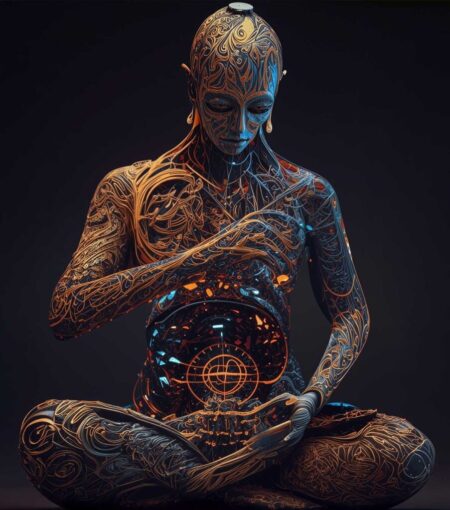
God is hundreds of billions of years alive and doesn’t need oxygen or facial features. God is consciousness living as resonance.
Hear Heaven
We’re consciousness living in a blend of light. An Angel says, “You’re an Angel.”
We don’t know other races as normal because we have never learned to see the human being as an outer layer of intelligence.
The concept of an other intelligence begins with the assumption that we already understand our own. We look at the human form, recognize a face, hear language, observe behavior, and call the entire phenomenon human. We have named the visible expression and then quietly mistaken the name for an explanation.
But what have we actually explained? Blood knew the architecture of our veins before we knew we had veins. The heart established its rhythm before we understood what a heart was. Cells divided without instruction from the person they would become. Organs differentiated. Neural pathways formed. The body organized itself through processes so intricate that the conscious mind arriving within that body would spend decades learning fragments of what had already occurred without its participation.
We did not teach ourselves how to become alive. Life knew something before the person knew anything. That should have opened an enormous question in the human mind.
Instead, we named ourselves.
Human.
The word gave us a boundary of knowing and not knowing. Once something has a name, the mind can begin behaving as though it understands what the name represents. We learned what a human looks like, how humans behave, what humans are supposed to want, and where a human being supposedly begins and ends.
But human names only the level presently visible to human consciousness. It’s not the Truth; it’s what we can muster up as a truth. The mind isn’t going beyond the walls of reality it shaped.
From birth, consciousness enters a world already underway. Language is here. Meaning is here. Families are here. Civilizations are here. Bodies are here. Stars are here. Love and suffering are here.
An immense biological order is already operating within us, and an incomprehensibly larger cosmic order is operating around us. We arrive knowing none of it. The infant does not create reality. The infant receives reality. Gradually, consciousness learns how to translate what is being given.
Eyes differentiate forms. Ears organize vibration into meaningful sound. Language divides an immeasurable field of experience into objects and concepts. Memory begins connecting moments. Attachment gives those moments emotional weight. Other people tell us what things are called and what they mean. A micro-reality forms.
At five years old, that micro-reality can feel complete. Mother may be enormous. Home may be the center of existence. Tomorrow can feel infinitely distant. Death may barely be conceivable. God may be an image supplied by adults. The universe may be whatever fits inside the child’s available imagination.
The child does not experience this as an incomplete version of reality. It is simply reality. Then consciousness grows.
At twenty-five, the same planet can contain an entirely different universe. Love has another depth. Parents have changed dimensions. Time has accelerated. Mortality has entered the landscape. The body means something different. Responsibility, intimacy, failure, longing, beauty, and loss occupy territories that could not have existed inside the five-year-old’s capacity.
The world did not necessarily become larger. The consciousness receiving the world did.
And still we assume that wherever adult human consciousness presently stands must be approximately where reality ends. Why? We already have evidence from our own lives that a reality can feel complete while being radically conditioned by the capacity perceiving it.
Perhaps we have mistaken the current bandwidth for the whole transmission.
The eyes are extraordinary, but they do not perceive everything that exists. The ears translate only what they can receive. The senses give consciousness a workable world; they do not certify that the world they provide is the totality of existence.
Even the body teaches us this. Look into a mirror. You see skin. You do not see the immense microbial populations participating in the body or bacteria crawling out of our eyes. You don’t see blood moving, immune cells responding, neurons signaling, proteins folding, hormones circulating, DNA being transcribed, or millions of microscopic events occurring while the reflected person thinks, There I am.
The mirror isn’t lying. It simply cannot show you very much of what is there. Consciousness has the same problem with reality.
We see what this level can translate. We hear what this level can translate. We think with concepts this level has made available. And then we construct human from the resulting picture. We’re not seeing deeper layers of creation or living in conversation with God.
The Costume
By childhood, the mind begins making a costume. A name becomes me. A face becomes me. A family becomes mine. Preferences become personality. Memories become history. Achievement becomes worth. Injury becomes identity. Culture supplies categories. Society supplies aspirations. Other people’s responses become mirrors through which the developing person continually discovers who they supposedly are.
Eventually the costume becomes so elaborate that we stop recognizing it as something constructed.
We say:
This is who I am. Yet almost none of what is keeping the person alive appears in that declaration. We do not say, I am the intelligence coordinating trillions of cellular events. We cannot, because consciously we are not doing it. We do not say, I am the intelligence beating this heart. We don’t know how to beat it.
We cannot even fully explain what consciousness is, yet consciousness is the very field within which every explanation we have ever produced appears.
There is something wonderfully disproportionate about this. The storyteller knows very little about the machinery allowing the storyteller to exist. Yet the storyteller confidently announces what reality is. This is where the human idea of self becomes too small.
We are not our thoughts. Thought is created light and only lives temporarily. When we leave the body, it never lives again as it has in this life.
The Invisible Library
Consciousness does not originate as privately as we imagine. The human mind is participating in a much larger field of intelligence than the individual can presently recognize.
This is where other orders of intelligence become interesting, not merely extraterrestrial bodies imagined through science fiction, but non-human orders of consciousness participating in creation at levels our present senses do not translate.
We come into existence already surrounded by intelligence we did not create. Some of it is visible. Some becomes visible only through instruments. Some remain outside the present capacities of human consciousness altogether. The deeper question, then, is not simply: Are there other races?
It is: What is intelligence before it takes the form through which human beings recognize intelligence?
If intelligence must have a human face before we recognize it, we are not studying intelligence. We are studying resemblance to our outer layer, which is also covered in bacteria.
Creation contains forms of knowing that do not think as humans think, perceive as humans perceive, or localize consciousness in the manner we presently call a person. They can live in the fabric of thought and human photosynthesis.
Human consciousness can then be understood not as an isolated generator but as a receiver and participant woven with levels of intelligence greater than the individual personality knows how to identify. We’re a blend of light in God, and those layers are not human consciousness; they are variances in God’s light beyond human living.
The library was here when we arrived. The word creates the world, and we learn to read one shelf. And then call it reality.
Matter as Translation
Matter is a nothingness only existing in consciousness. Conscious Energy is the fabric of the world. Conscious Energy is a race of Heaven and is the mass, force, velocity, temperature, and levity in all matter.
Matter gives consciousness extraordinary definition. Here is the hand. Here is the tree. Here is another person. Here is distance. Here is consequence. Here is something I can touch and something I cannot. Matter gives boundaries to experience and allows consciousness to recognize itself through difference.
Without the mirror, the thought has no visible reflection. This is why matter is the gift God gave human consciousness. Matter gives the invisible somewhere to become experience. But the canvas should not be confused with the painter, nor the reflection with everything being reflected.
The body is a temporal instrument through which consciousness experiences this particular order of reality. The body belongs to the visible architecture. Spirit belongs to the deeper light of our livingness.
The Soul is like the Sun and Spirit is like its rays, giving movement for living in matter. The Soul is not merely an object stored inside a human costume. The Soul stays in Heaven while Spirit carries matter. Spirit is its living expression into experience, moving, illuminating, translating, maintaining relationship with what lies beyond the temporary form.
The body changes. The costume changes. The narrative changes. But the deeper proposition is that the livingness wearing the costume exceeds it. Consciousness is continuous while thinking fades with the body. This story is one out of an infinite.
The Many Within the One
This is where “human” can begin opening.
We have learned to experience ourselves as one.
One body. One name. One biography. One narrative. One voice inside the head.
Yet even materially, we are already multiplicities organized into apparent unity. Countless living processes cooperate to produce the experience of one organism. Consciousness has depths of organization we understand even less.
What appears to us as an individual light participates in a tapestry of intelligence that cannot be perceived from the level of the costume. The many as one stops being merely poetic. It becomes an ontological living.
We may be individual without being isolated. Distinct without being separate. A particular resonance within something infinitely larger. Consciousness is a pool of consciousness converging for one light to know itself for a brief time in matter.
A variance in God’s Light. Not God in His totality. Not the human ego elevated until it declares itself Divine. Almost the opposite. The little self becomes less important because consciousness discovers that its livingness belongs within an order unimaginably greater than the idea of the person.
The word Light points toward something language cannot quite hold: intelligence, livingness, intelligibility, creative order, Love an infinite capacity within God from which different expressions of consciousness arise.
As consciousness shifts from the world living outside of us to the world only living through us. We recognize an echo of thought building life. Through depth, substance, and maturity, we move through layers to know there is only one of us here with God. The story is elaborate and feels very real, but it is an illusion leading us to God.
Walking Out of the Skin
This is what we have been missing when we say that we are human beings. We are describing the journey by its clothing.
The human form matters enormously because it is where this particular curriculum is occurring. We love here. We suffer here. We choose here. We encounter separation here. We learn what attachment does to consciousness. We discover compassion through another person’s pain. We acquire depth through circumstances that could only have meaning because matter made them experiential.
But matter’s level carries the human story for living through, not settling in.
The deeper movement is from the costume toward the wearer. From thought toward consciousness. From consciousness toward Soul. From separateness toward relationship. From the visible toward the invisible order already carrying the visible. From our human idea of God toward God beyond our present capacity to know Him.
That is why keeping God above all things keeps Light in our eyes. It continually reminds the mind that it has not reached the top of reality.
There is more. More life than the senses report. More intelligence than the human form displays. More consciousness than the personality can possess. More creation than matter reveals. More of ourselves than the mirror returns.
And infinitely more of God than the human mind has yet been capable of receiving. We are walking out of the skin long before the body dies. Every relinquished identity loosens it.
Every deeper question loosens it. Every moment in which we stop making the visible the boundary of the real loosens it. Every surrender of the little self gives consciousness another opening through which Light can enter.
Human begins to mean something entirely different. Not the final definition of what we are.
A temporary configuration through which something eternal is learning to see. A localized experience within an immeasurable field. A consciousness awakening inside creation and slowly discovering that the world contains vastly more life than the level into which it was born could initially perceive.
Human is a variance in God’s Light, experiencing creation from one level of consciousness within an infinite reality.
Our deepest evolution begins when we stop asking only what a human being is and become quiet enough to ask:
What is living through one? A variance of God.
