
Buddha
The Soul walks through stories, carving itself into light.
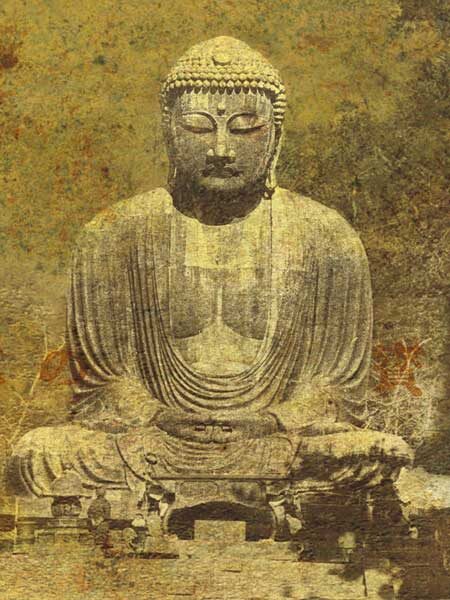
Buddha’s life illustrates this pilgrimage. His journey is not a religious template but a universal blueprint: God accompanies every Soul, whether or not we know His name. Siddhartha Gautama, who became Buddha, never spoke of a Creator, yet he moved within Divine design.
Enlightenment is woven into life’s fabric, independent of ritual, title, or institution. The papacy, bishops, cardinals, rabbis, and imams may claim spiritual authority, yet depth is not granted by position. Siddhartha found what no hierarchy could bestow by following the fire within his own Soul.
He was born to royalty, cocooned in silk and protection. His father shielded him from sickness, aging, and death, believing comfort could engineer destiny. But comfort cannot quiet the Soul’s deeper questions.
One night, Siddhartha passed beyond the palace gates.
There he encountered what had been hidden: a body weakened by illness, a man bent with age, and a human being nearing death. The shock fractured the curated world he had been given. It was not philosophy that stirred him, it was rupture.
That rupture lit a flame.
Losing our lives to gain them in God
isn’t a religious idea.
It’s the unveiling of God’s light.
Siddhartha Gautama — The Prince Who Walked Beyond the Walls
Not a search for a religion.
Not a search for a God he could name.
But a hunger to understand suffering at its root.
That hunger was the spark.
Every human being, created by God whether conscious of it or not, will at some point step beyond inherited walls. We see something that does not fit our narrative. We feel something that destabilizes identity. In that moment, destiny begins to whisper.
Siddhartha left the palace and his newborn son. He traded silk for coarse cloth. He sought truth among ascetics and nearly disappeared into extremes. Yet even severe discipline could not satisfy him, because truth is not found in ideologies, doctrine, or performance.
So he turned inward.
He walked past indulgence. He walked past denial. He walked past every constructed system.
And beneath a quiet tree, he awakened not to a title, not to ritual but to a light already present. Even though Siddhartha never knew God, he lived deep enough in Christ to have light for living with enlightenment.
Buddha’s path reveals something profound: once the Soul’s longing ignites, no institution can contain it, and no ideology can manage it. The unseen current of God moves beneath all systems, guiding each life toward deeper light. Creation’s knowing wasn’t living when Siddhartha was. He didn’t know that only one of us was here with God, living through our narrative to Truth. No one needs to believe in God because His light builds the current through which all life flows.
We do not need to name that current for it to carry us.
We only need to follow where it leads.
The depth we acquire on this path begins to dissolve the identity built solely in matter. It loosens every rigid image of God shaped by fear or ego. What remains is not dogma, but communion.
The blueprint of life exceeds ideology.
When the Soul follows its spark, it is already walking with God, even before it knows the Name.
Moses — The Fire Beyond Identity
The Soul walks through stories, carving itself into light.
If Buddha reveals the spark ignited by suffering, Moses reveals the spark ignited by encounter.
Moses was born into danger, placed in a woven basket upon the Nile to escape death. Found by royalty and adopted into Egyptian power, he grew up between two identities: Hebrew by birth, Egyptian by privilege.
His early world was polytheistic. Egypt was filled with gods of river and sky, sun and soil. Moses was trained within that cosmology, surrounded by temples and deities shaped by culture and empire.
Yet the identity built by the system is never the final layer of a Soul.
One day, he crossed an inner threshold. He learned of being adopted and that his people had been his slaves. His brother and sister were living as slaves.
He witnessed the injustice of a Hebrew slave beaten under Egyptian authority. Something ruptured inside him. The fire was not yet a divine revelation. It was a moral awakening. He intervened, committed murder, and, in fear and confusion, fled into exile.
Like Siddhartha leaving the palace, Moses left power, royalty, and luxury behind.
He became a shepherd in the wilderness, anonymous, stripped of status. Years passed. Silence deepened. The Soul was being carved quietly.
Then came the bush that burned but was not consumed.
In that moment, Moses did not discover a new religion. He encountered Presence.
The Voice did not introduce philosophy. It spoke identity: I Am.
Here, the Soul shifted from inherited gods to a living encounter with God. Moses moved from a polytheistic atmosphere into monotheistic intimacy, not because ideology convinced him, but because fire called him by name.
The burning bush was not merely a spectacle. It was recognition.
Just as Buddha awakened beneath a tree to light already present, Moses awakened before a bush to God already guiding him. Both men stepped beyond the narratives handed to them. Both responded to a spark that could not be quieted.
Moses’ life did not become easier after the fire. He returned to Egypt. He faced Pharaoh. He led his people into the wilderness, into uncertainty. The path of the Soul rarely returns to comfort once awakened.
But something had changed.
He was no longer walking by the inherited story.
He was walking with God by encounter.
The blueprint is the same: every human being is carried within God long before comprehension. Sometimes we awaken through suffering. Sometimes through fire. Sometimes through exile.
The depth we acquire on this path dissolves borrowed identities. It breaks allegiance to fear-based images of God and replaces them with lived communion.
Buddha sought the end of suffering.
Moses responded to the Voice in the flame.
Different languages.
Same current.
The Soul walks through kingdoms, deserts, trees, and fire, carving itself into light. No religion can carry God; only the individual’s Soul can.
Jesus Christ — The Wilderness Within
The Soul walks through stories, carving itself into light.
If Buddha awakened beneath a tree, and Moses before a burning bush, Jesus entered the desert.
After His baptism, before teaching crowds, before miracles, before following, He went alone into wilderness. Not to perform. Not to gather disciples. Not to establish doctrine.
He went to break bread in silence.
The desert strips identity. There is no palace. No temple. No applause. Only hunger, heat, and the echo of one’s own interior. There, He faced temptation, not merely of appetite, but of power, spectacle, and control. The invitation was subtle: turn stones into bread, prove yourself, claim kingdoms.
Each temptation offered identity without surrender.
But Jesus chose alignment over dominance.
He did not prove Himself through miracle.
He did not seize authority through force.
He did not secure safety through spectacle.
God placed His light in matter at the holy inception. He answered from within.
The wilderness was not sentence. It was clarification.
Like Siddhartha leaving luxury, like Moses fleeing into exile, Jesus stepped away from structure before stepping into destiny. The desert refined intention. It separated the thought system walking in the clothes of the world into light.
And here is the deeper pattern: Before the Soul carries light outward, it must face its own shadows inward.
Jesus did not live discovering God in the desert; He confirmed communion. The wilderness revealed what could not be shaken. When He emerged, it was not with ideology, but with light.
The blueprint carries the same.
Every human life will enter a wilderness season. A place where inherited systems fall silent. A place where temptation whispers shortcuts to power, validation, or control. A place where the Soul must decide what it truly serves.
We do not awaken through comfort. We awaken through encounter.
Buddha faced suffering.
Moses faced fire.
Jesus knew worldly ways did not know Him.
Different landscapes. One current is moving beneath them all. God.
The unseen Presence does not belong to a single religion. It is the undercurrent guiding each Soul toward deeper light. Whether named or unnamed, acknowledged or denied, it moves.
The Soul walks through kingdoms, deserts, trees, and flame — carving itself into light. And when it emerges, it does not carry dogma. It carries Love.
The Pattern Beneath All Stories
The Soul walks through stories, carving itself into light.
Across continents and centuries, the names change. The languages differ. The rituals and garments vary. Yet beneath the diversity of doctrine, something steady moves.
Beneath Siddhartha’s awakening under a tree…
Beneath Moses standing before fire…
Beneath Jesus in the wilderness…
There is a pattern. The pattern is departure. Each left a constructed world.
Siddhartha stepped beyond palace walls and saw suffering.
Moses fled from identity built in empire and entered exile.
Jesus withdrew from society and entered desert silence.
Before illumination, there is separation.
Before clarity, there is rupture.
Before mission, there is wilderness.
The Soul must cross a threshold.
Not because God is absent, but because comfort conceals depth. The inherited world, whether built of luxury, power, religion, or culture, cannot contain the full architecture of Truth.
So something destabilizes it.
A sick man.
A burning bush.
A calling in the desert.
The rupture is never random. It is the moment the Soul realizes the story it was handed is not the whole story. And then comes longing/destiny.
Not ambition. Not institutional loyalty. Not performance.
Longing. Burning. Deeper calling.
Siddhartha longed to understand suffering.
Moses longed to reconcile identity and justice.
Jesus longed to align entirely with the Father’s will.
Longing is the fingerprint of God within the human being. It is the spark that cannot be extinguished by comfort or silenced by ideology. The pattern beneath all stories is this: The Soul is drawn beyond what it knows, into what it cannot yet name.
Some awaken without speaking the word “God.”
Some awaken by hearing “I Am.”
Some awaken through surrender to Love itself.
The forms differ.
The current is the same.
God is not confined to systems built in His name. He moves through human history like an unseen river, shaping, calling, refining.
Enlightenment is not owned.
Revelation is not trademarked.
Awakening is not denominational.
The blueprint exceeds ideology.
When the Soul follows its spark beyond walls, beyond fire, beyond wilderness, it is already walking with God. Not toward Him. With Him. And in that realization, stories cease to compete. They begin to harmonize.
Beyond walls, beyond flame, beyond desert silence, the Soul enters a field where language thins and Presence thickens.
Here, no story stands alone.
They interweave like constellations, distinct, yet part of one sky.
God is uncovered. Every thought leads the way.
The Soul walks through stories, carving depth in God, remembering it was Him all along.