
Awareness & Reality
“We were seeing before we knew what thinking was.”
We can go back to Cain and Abel, to Noah’s Ark, and to the earliest stories human beings carried about themselves and see a thinking species trying to understand an order much larger than its own thought.
Long before humanity built universities, governments, economies, religions, or systems of credibility, nature was already carrying an order.
Seasons changed. Seeds opened. Water moved. Bodies formed. Life reproduced itself. The Earth turned without human instruction. A child did not have to understand sunlight for sunlight to reach the body. The heart did not wait for an education before learning to beat. Life was already moving through an intelligence the human being had not named.
Creation preceded our explanation of creation.
Blood knew it was going in our veins before we knew what blood was.
This is where our story begins. We do not enter an empty world and decide what it will become. We arrive inside something already moving. No human being chooses to be born.
We do not choose the century. We do not choose the country. We do not choose the family. We do not choose the first body we encounter as ourselves. We do not choose our earliest nervous system, physical characteristics, genetic inheritance, or many of the dispositions through which the world will first be received.
Some are born into enormous wealth. Some into poverty. Some into tenderness. Some into violence. Some into homes filled with books and possibility. Others arrive where survival occupies almost every room.
Before free will becomes meaningful, an enormous amount of life has already been given. We’re created and living in a world with higher intelligence.
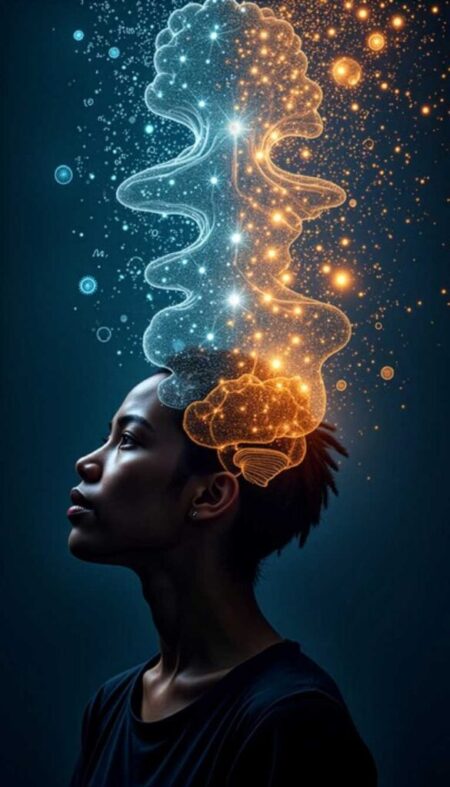
Thought is only living for moving through a temporal story.
This complicates our idea of the human being as an entirely self-determining creature. We carry consciousness but did not create consciousness. The formation of the thought system wasn’t primitive awareness. The word already had meaning.
Our existence seems to contain both choice and given, free will and conditions we never authored. We exercise ourselves inside a field whose first coordinates were placed before we were capable of choosing anything.
Even small things reveal higher intelligence and creation. One child loves cherries. Another cannot tolerate their taste. One is drawn instinctively toward sound; another toward numbers, animals, movement, solitude. Long before the person constructs an explanation of self, something is already expressing through the life.
There is first awareness before there is a philosophy of awareness. The primitive awareness is creation and the intelligence within us.
A newborn does not know that it is American or Chinese, wealthy or poor, Jewish or Christian, educated or uneducated. It does not know capitalism, socialism, theology, prestige, academic authority, celebrity, borders, historical narratives, or social class.
It is simply alive.
The flower enters soil already interacting with an environment it did not create. Human consciousness likewise enters a world already in motion. But there is an extraordinary difference. The flower does not appear to construct an ideological explanation of the soil. The human being eventually does.
The Second World
The child is born into creation, but very quickly enters a second world made of meaning.
Words begin arriving. Mother. Father. Good. Bad. Mine. God. Country. Money. Success. Smart. Beautiful. Normal.
The word begins organizing experience. And the child cannot initially know that the meaning attached to a word has a history. It cannot know that another civilization might organize the same experience differently. It cannot distinguish what humanity discovered from what humanity assumed, what was observed from what was interpreted, or what belongs to creation from what belongs to convention.
The world speaks before the child can question the speaker.
That may be one of the most consequential conditions of human consciousness. The child receives creation and interpretation almost simultaneously.
A tree is there. The word tree is given. A body is there. An identity is given. The sky is there. A cosmology is given. Death is there. An explanation is given. God is there. A religion may be given.
Eventually the distinction between what is and what we have been told it means becomes almost invisible. This is how first awareness becomes inherited awareness.
The Library Was Already Here
Human consciousness therefore enters a library it did not write.
Language was already here. History was already here. Economics was already here. Religion was already here. Science was already here. Government was already here. Universities were already here.
Measures of intelligence, achievement, beauty, morality, credibility, and success were already here. Institutions already carried legitimacy before the child could ask what legitimacy meant.
Human beings created human education by shaping a measurement of intelligence. We lived for what worked for us, not for knowing beyond it.
Certain people were called authorities. Certain books were called important. Certain institutions were called prestigious. Certain explanations were called knowledge. Certain possibilities were called impossible. The developing human being does not usually stand outside this architecture and evaluate it before entering.
We enter first. Then we learn to think from inside it.
Throughout childhood and education, the library becomes increasingly sophisticated. Mathematics gives relationships names. Science gives physical observations frameworks. History gives the past narratives. Religion gives eternity narratives. Economics gives value systems. Society gives identity coordinates.
No one knows where thinking is coming from or who is thinking. We don’t question what reality is and isn’t. We don’t question what being alive is or isn’t? No one really knows Spirit or the invisible world.
We have a library being given and assumed without any idea of what is beyond the face value, thinking that placed it. The trial is not that humanity created a library. The trial begins when the library becomes the perimeter of reality.
Knowing and Not Knowing
Every word creates a distinction. And every distinction quietly creates an outside. Once something has been named knowledge, something else becomes not knowledge. Once something has been called credible, something else becomes incredible. Once something has been defined as possible, something else becomes impossible.
The developing person gradually acquires a perimeter of knowing and not knowing without realizing that a perimeter is being built.
These walls rarely feel like walls. They feel like reality. That is why credibility becomes so powerful. A documentary carries production and authority. A professor carries credentials. A university carries a name. A government carries seals, buildings, offices, titles, and historical legitimacy. Religion carries scripture, vestments, architecture, ritual, lineage, and authority. Science carries laboratories, journals, institutions, methodologies, and accumulated evidence.
All of these forms are part of the story and are temporal. The illusion passes through many layers of humanity’s idea of credibility and legitimacy. Religion doesn’t live with God in conversation and carries ideas from thousands of years ago instead of knowing Him today.
Science has no idea how matter exists and has no way to see beyond the observer’s narrative. The institution was created by human beings believing something is knowledge and then making that measurement so. We’re on a planet in space, making our best ideas exist as well as we can for living through them.
The appearance of authority can make it difficult for consciousness to distinguish between two very different things: what humanity presently knows, and what reality is.
Those are not the same perimeter.
The Construction of Credibility
Human beings eventually begin validating the library with the library.
Universities credential people who become professors who teach the knowledge recognized by universities. Institutions recognize authorities whose authority strengthens the institutions recognizing them. Books cite books. Histories inherit earlier histories. Cultures repeat interpretations until repetition begins resembling self-evidence.
Agreement acquires tremendous power. Eventually millions of people can inhabit the same conceptual structure and experience that agreement as proof that the structure represents the whole. Yet consensus tells us something important about human agreement. It does not necessarily tell us the outer boundary of creation.
The distinction is subtle because humanity feels discovery and feels part of a collective knowledge. No one thinks about what reality is and isn’t or who is thinking. We don’t see the illusion, and we live everything at face value, as if it’s real.
We can’t see the totality of anything. We see only what we think is here, but there is more here beyond how we think. We’re not interacting with God, Heaven, or other races in our light.
Creation Never Entered the Classroom
This is where we can return to the beginning.
The child was alive before education. The heart was beating before biology class. Consciousness was receiving before psychology. Matter was organizing before physics. Algorithms had motion before eyes could see.
The stars existed before astronomy. God did not begin with theology.
Creation never needed human credibility in order to exist. Something extraordinary happens when we recognize this.
The library can remain. Science can remain. Education can remain. History can remain. Language can remain. Human knowledge can remain, but the walls between knowing and not knowing begin to thin as people learn more.
Creation has varied with human stories. What existed in 1 AD doesn’t exist today. And no one knew in 1 AD that satellites, TVs, computers, heart transplants, or satellites could exist. It wasn’t part of human consciousness in 1 AD. Those words didn’t exist.
We ask: What belongs to creation, and what belongs to our interpretation of creation?
What did we actually discover? What did we inherit? What do we know? What did we name? What did we agree upon? What did we mistake for final because everyone around us was standing inside the same measurement? And what other races of Heaven have always been here that our present level of consciousness simply does not yet know how to receive?
God created human consciousness to know Him. The word created the world, and meaning is placed with every word. Consciousness is all that is alive. We learn meaning throughout childhood. It’s already woven in the collective consciousness that creates what we carry.
Meaning gives reality to our narrative; it’s what we can interpret, receive, and accept. As children, we don’t have the depth to question our parents about reality. Life feels very real. We can drink something hot or eat something cold. Our thought system shapes reality through the meaning and attachment we place on each word.
First awareness isn’t primitive awareness. It’s the instant before humanity tells consciousness what existence means. First awareness is learned awareness and and is human consciousness not quite organized in the layers of thought.
We can assume meaning or go beyond it. We can restructure what we believe and where we place our self-identity in matter, absorbing what lies beyond it. First awareness is a deeper choice: to accept or not, and to absorb more than what is. The mind wants to live in its knowing and not knowing and refuses to see openly for more. First awareness can choose what is carried or retained.
We quickly begin shaping a thought system for a level of thinking. Consciousness is the light from which thinking emerges. The mind is developing through the five senses and what is tangible. It reads what everyone else accepts.
Ego
When we place self-identity in matter, we carry lower earthly energy in our thinking.
The child receives a world of meanings, constructs a self from those meanings, and then begins protecting the self that the inherited world taught it to become.
Self-identity in matter makes the little person’s reality appear to be reality itself, while the deeper movement is light in a pool of consciousness, giving it a way to live in matter within its own idea. We don’t live knowing God as our mother, father, brother, or sister. We don’t relate to Spirit over the body or live knowing other races of Heaven.
We were born into creation, but educated into an interpretation of it.
Before humanity told us what the world was, we were already alive inside something infinitely deeper than the explanation.
Everything here is a variance in God’s light and a temporal story. It’s living at the observer’s level of consciousness and exists for eighty, ninety, or a hundred years. When we leave the body, everything we believed was family, history, lineage, and life…fades. It never lives again.
Being created means we are blended with more than our idea of human and living in something beyond our idea of reality. Living in something is Heaven’s level of life, and we’re being raised by light beyond human consciousness. The world already existing when we arrive is placed perfectly at our level of consciousness.
We have pieces of life for carving depth, substance, and maturity. Thinking carries smoothness and friction from ego and satan. The meaning and self-identity we place in matter need to defend their ideas of being better, worse, right, and wrong.
Thinking must travel down different roads, building other lenses to see from, including roads it could not know; something exists to carry it into new frontiers.
Everything in life has been created and is being supported, whether good or bad. Nothing lives without higher intelligence. We feel free, and we feel like we live only in human ideas; but life is much larger and more complex. Layers of life exist in different places of consciousness, far beyond the human world’s livingness.
Reality is the illusion placed by human beings not knowing God or Heaven on earth. The mind accepts what is given instead of leaving the world to know more beyond its face-value thinking.
