
The Worlds Within Thought
Human Consciousness, the Intelligence Beyond Us, and the Infinite Possibilities of Living with God
We come into a world already existing. Before we speak our first word, humanity has established a way of living. There are languages waiting for us, countries with borders, governments with laws, economies with systems of exchange, religions with inherited understandings of God, and families carrying generations of beliefs about what life is and what it means to be human.
We enter this enormous human story and gradually learn to participate in it. We shape the idea of self not knowing Spirit. We shape the idea of thinking not knowing consciousness.
We are taught what is valuable, what is necessary, what constitutes success, what should be feared, and what is possible. We learn how to navigate the world long before we understand that the world we are navigating is itself a human construction, shaped through thousands of years of collective thinking.
Collective idealizing doesn’t carry Truth; it has acceptance and what is brought into being as truth. An extraordinary realization is that the thought system into which we are born is not the entirety of thinking. It is one historical expression of it.
We are living within one arrangement of human understanding, one civilization’s interpretation of reality, one level of awareness among possibilities that are immeasurably greater than anything humanity has yet conceived.
We can only live in our narrative through what we think is here. But more exists beyond how we think. The mind won’t escape itself if nothing changes the idea of it. We carry more with us, living to know creation and God.
The mind needs Love to calculate at higher rates.
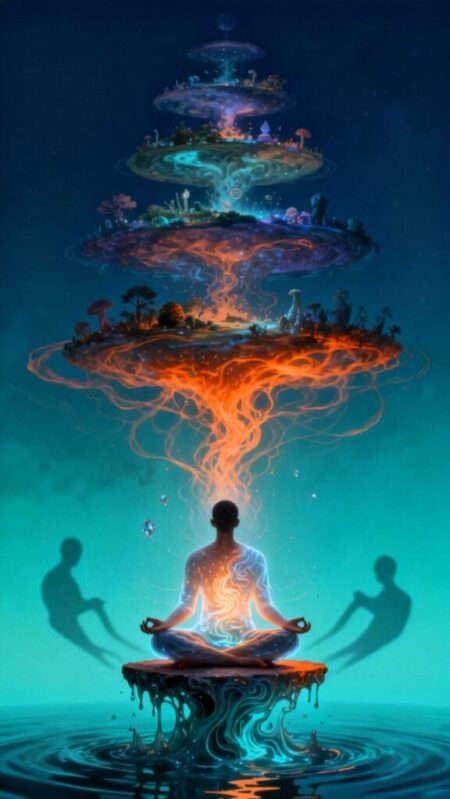
Thought is only living for moving through a temporal story.
The World of 1 AD Was Another World of Thought
Imagine entering human life in the year 1 AD.
The Earth was the same Earth beneath our feet today. The sun illuminated the morning. Rivers moved through landscapes, mountains rose into the sky, and human beings experienced love, grief, wonder, uncertainty, and the mystery of being alive.
Yet the world of human thought was profoundly different.
There were no modern nations as we understand them, no electrical networks, no instantaneous global communication, no modern scientific institutions, no digital economies, and no understanding of the universe comparable to what humanity possesses today.
Daily life was organized through different relationships with land, family, empire, religion, agriculture, labor, and survival.
The world was not a single uniform civilization. A person living under Roman rule inhabited a different cultural and political environment from someone living in Han China, in the Americas, or within the many communities of Africa. Each inherited a particular account of reality, shaped by its language, traditions, knowledge, and institutions.
What people knew about the world influenced what they imagined could exist within it.
The very meaning of a journey was different. The meaning of distance was different. The relationship between an individual and the wider human population was different. The opportunities for learning, communicating, and participating in distant events were different.
A person’s daily thinking was occupied by the realities of that historical world. And yet, the consciousness experiencing that world was not necessarily confined to its knowledge.
A human being in 1 AD could contemplate eternity without understanding astrophysics. Someone could experience profound love without possessing a modern vocabulary of psychology. A person could encounter the mystery of God without knowing Heaven on Earth.
The limits of a civilization’s knowledge are not necessarily the limits of consciousness itself. This distinction is essential.
Humanity in 1 AD did not inhabit a different physical universe. It inhabited a different world of human understanding. Consciousness was shaped by a thought system that placed different meaning and attachment at matter’s level. Self-identity in matter held another idea of human living. And what we call the modern world is another such world.
The Invisible Architecture of Daily Thinking
Consider the ordinary mental activity required to live in the twenty-first century.
We manage passwords, accounts, financial transactions, schedules, transportation, appointments, messages, devices, subscriptions, purchases, employment, family obligations, and an almost continuous stream of information.
Each activity may be relatively simple, but collectively they occupy an extraordinary amount of attention. We remember, calculate, compare, organize, respond, correct, and repeat. We become remarkably proficient at maintaining the machinery of our daily lives. But how much of this thinking contributes to an expanded understanding of existence?
How much deepens our awareness of consciousness, the living Earth, the universe, or God? And how much merely enables us to continue functioning within the systems humanity has already created?
There is nothing inherently inferior about practical thought. The ability to organize life is an extraordinary human achievement. But a civilization can become so occupied with managing its own complexity that it leaves comparatively little room to question the purpose of that complexity.
We may spend our lives learning how to succeed within a system without asking whether the system represents the fullest expression of human possibility. We may become experts in managing existence while remaining comparatively unfamiliar with the consciousness through which existence is experienced.
Humanity is living in incessant thinking, jumping from one thought to the next; our thinking is devoted to maintaining a world we have not know anything about. We don’t know who the self is or isn’t, or where thought is coming from.
The Environment of Thought
Thought does not develop in isolation. Thought is created light beyond the individual idea of self.
A child born in New York encounters a different cultural environment from a child born in Japan. Their languages, social expectations, educational systems, and inherited histories may differ substantially.
Yet both enter a human reality that existed before them.
Neither invented the concept of money, government, property, employment, or national identity. These were already established as meaningful structures within their societies. They are temporal ideas that build stories for this level of consciousness.
We come into the world that already has a library of words that shape the world. Over time, the child learns not only how to use these structures but also how to think through them. The environment becomes part of the architecture of thought.
What a society rewards becomes something people learn to pursue. What it fears becomes something people learn to avoid. What it treats as impossible may remain unexplored for generations.
This is not to say that human beings are entirely determined by their cultures. Individuals continually question, resist, reinterpret, and transform what they inherit. But life is sliding into only placing ideas within the collective knowing and not knowing. The collective human thinking creates an environment in which individual thinking develops.
Our institutions, technologies, economies, and cultural narratives are not merely external arrangements. They are expressions of ideas organized into daily reality. We have placed credibility and legitimacy not on Truth but on acceptance. What was seen as Truth in 1AD wasn’t the entire scope of life or what existed at that time. It was only based on what could be thought of at that time. We live inside the consequences of human thought. And through our participation, we contribute to the world of thought that future generations will inherit.
We have a greater responsibility to live toward the light so that human thinking remains capable of conscious evolution.
The Collective Human Story
Humanity’s collective mind need not be imagined as a single literal brain shared by billions of people. Human photosynthesis is carrying the light of human ideas. It’s made of the Love we are living and the Love we are not living.
Human knowledge, memory, and meaning are distributed through languages, relationships, institutions, technologies, art, and cultural traditions.
No individual holds the entirety of civilization within their own understanding. Yet civilization exists through the contributions of countless individual minds. Every country, culture, community, and family participates in this unfolding human story. We are born into it, experience it, and help perpetuate or transform it.
The collective story itself represents only one layer of a far greater reality. We are connected to much more. The human world we recognize is not the destination of consciousness, but a temporary expression of what human consciousness has learned to organize.
We often look backward at earlier civilizations and recognize the limitations of their understanding. Yet we rarely look at our own civilization with the same imaginative distance.
A person living two thousand years ago could not have anticipated much of the world we now inhabit. Why should we assume that our present civilization represents anything close to the final possibilities of intelligent existence? There are ways of understanding life, intelligence, relationship, and reality that are as unfamiliar to us as our modern world would have been to someone living in antiquity.
We’re not moving into our thinking with depth, substance, and maturity. We live in a layer reacting to the five senses, what is tangible, and the human story. We don’t get beyond the walls of mainstream.
Intelligence Beyond the Human Thought System
Human intelligence is extraordinary, but its present form is far from the possibilities of intelligence.
We have developed languages, mathematics, sciences, philosophies, and technologies that enable us to investigate realities once inaccessible to human understanding. In Sumerian days, many ideas in math were shaped and still live on today.
We have discovered that the Earth is one planet orbiting one star among an immense population of stars and galaxies. We have learned that the visible world emerges from physical processes far more intricate than ordinary perception reveals. And we have begun creating artificial systems capable of performing increasingly complex intellectual tasks.
What we see as a universe, atom, galaxy is one moment in living that only touches one tiny idea in human consciousness and is temporally living for what we believe it to be.
Yet the existence of intelligence beyond the human form remains a much larger quest.
Conscious Energy is the fabric of the world, and Heaven’s level carries more races than we know. Life is a complex pool of consciousness, able to shift on a dime so reality can open to more.
Our minds have developed within particular biological, environmental, and evolutionary conditions. Our senses reveal only certain aspects of the physical world. Our languages organize experience through concepts inherited from human history.
We have understanding while still perceiving only a small portion of what is possible. Human thinking is one expression within a far greater field of conscious existence.
The greatest limitation of intelligence is the assumption that what it presently understands defines the boundaries of what can be understood.
God Beyond the Human Construction of Reality
Here the question becomes more intimate.
If humanity lives within historically conditioned thought systems, then even our ideas about God are expressed through those systems.
The language through which people understood God in the ancient world was shaped by their cultures, political arrangements, religious institutions, and inherited explanations of existence.
The same is true today. We speak of God through words, traditions, images, doctrines, and concepts developed within human civilization. We carry what was given from thousands of years ago instead of living with God today.
Yet, God is the source of existence and cannot be confined to the limitations of any historical human understanding. God does not belong to the first century, the twenty-first century, or any civilization’s particular account of reality.
God’s existence is not dependent upon humanity’s present ability to describe it. The human thought system changes. God, if understood as the eternal source of existence, is not limited by those changes.
Our deepest encounter with God does not begin by accumulating more descriptions of the Divine, but by recognizing the limitations of the descriptions we already possess. Human beings have often organized religious life around authority, doctrine, ritual, and institutional belonging.
These traditions are mainstream ideas in satan, only living for those who do not walk outside the world to God. No institution has any historical language that exhausts the infinite nature of God. The mystery of God, infinite, exceeds every structure humanity has created to contain His existence.
There is a profound distinction. There is what humanity believes about God. And there is God. The two are profoundly different.
Consciousness Is Not Limited to the World It Encounters
When we enter human life, we encounter a world of forms. We learn the names of things. We recognize our bodies, families, surroundings, and relationships. We gradually construct an identity within the world. But the awareness through which we experience all of this is through more than the idea of self and human thinking.
We can study neural activity and investigate the relationship between the brain and conscious experience. Yet the full explanation of subjective awareness is creations light. Consciousness is not merely a product of the world we perceive, but participates in a reality greater than the world our senses disclose.
The human thought system is not consciousness itself. Thinking is temporal, its the storyteller, and is at matters level. The Soul is consciousness and is the light thinking emerges out of. We are a localized field in consciousness.
The organization of concepts, memories, perceptions, expectations, and interpretations operates within a conscious experience. Our thoughts can change. Beliefs can change. Civilizations can change.
The individual experiences the world at their level of consciousness and lives in only one level of consciousness out of an infinite. No demonstrated boundary of human understanding establishes the final boundary of consciousness.
The Possibility of a Different Human World
If we could visit the world of 1 AD, we would encounter people living within a reality that, in many ways, would feel unfamiliar to us. Yet those people were human beings, experiencing existence through the possibilities and limitations of their historical environment.
Two thousand years later, the world of human thought has changed beyond anything most of them could have anticipated. And still, we are not finished.
What might humanity become in another thousand years? What if future generations regard our current understanding of consciousness as preliminary? What if our present ideas of intelligence, education, governance, success, and human identity seem to them as historically limited as many ancient assumptions seem to us? What if humanity learns to organize civilization around the development of consciousness rather than the perpetual management of its own demands?
We come into a world already existing, and it has a celestial history, present and future. The library carries ideas that can shape into more.
God has always been present beyond the boundaries of human thought. The story of Abraham led us to that knowing. What has always been the depth in the human being is our capacity to recognize His presence.
The first-century human being looked toward the heavens without knowing the immense physical universe that science would later tell. We look toward those same heavens with telescopes, spacecraft, mathematics, and knowledge unimaginable to earlier generations.
We are learning to cultivate more space to contemplate and get beyond the walls of our comfort zone. Yet the deepest question remains. What is this existence in which we find ourselves? We have expanded our knowledge of the universe enormously without knowing who is thinking, how matter exists, or what the illusion is. The human story keeps living in what we can bring into being, despite our lack of knowledge. We haven’t begun to understand what it means to be alive and who is living.
Beyond the World We Have Inherited
We are not required to regard the world we inherited as the final expression of what human life can be. The systems surrounding us were created, developed, and sustained through human thought. They can be examined. They can be transformed.
The meaning of success can change. The purpose of education can change. The architecture of governance can change. Our relationship with technology and the Earth can change. And the understanding of self can deepen.
Human consciousness need not remain organized primarily around the demands of the world it has already created. The world we are of is larger than the reality we live. The human story is only one chapter in a reality whose possibilities exceed everything we presently know.
We have inherited a world of thought. We are not confined to its boundaries.
Our journey toward greater consciousness is not a journey away from the world, but toward a deeper understanding of the pool of consciousness we are part of. The local point of awareness is shaped by other races in our light.
A life in which intelligence is not limited to calculation. In which success is not limited to accumulation. In which existence is not limited to survival. And in which the human mind is no longer so occupied with maintaining the familiar that it has little opportunity to encounter the extraordinary.
We are living within one expression of consciousness. One human world. One historical moment. But existence itself is beyond our ideas of human, reality, and God. It is beyond anything our present thought system can imagine.
The future of humanity is not simply to build a more advanced world, but to become conscious of how much more there is to living than the world we have already built.
The human is the blend of intelligence living in God’s light. We are a variance in God, and the different levels of intelligence that shape our ideas, from a five-year-old to the forty-year-old, are races of intelligence beyond our awareness.
God is never confined to our ideas, never diminished by our limitations, and never dependent upon our recognition to be present. The individual is the only one who can know God, and the only one carrying the light for living in matter.