
Consciousness and the Birth of the Thinker
The mind is a tool for moving through matter, while the world is a place through which the Soul travels.
We experience life through a localized field of awareness. No one else thinks our thoughts for us. No one else occupies the exact interior world through which we receive a room, a face, a relationship, a star, a loss, or a lifetime.
Everything we call my life has had to become experience within consciousness. The human story is one layer. The body is one layer. The sensory world is one layer. Society is another.
Each becomes extraordinarily real within the narrative through which consciousness experiences this particular world. Yet consciousness, capable of becoming aware of all these layers, already presents a mystery greater than any one of them.
We can observe the body. We can observe society. We can observe thought. We can even become aware that we are thinking. So what is the awareness to which thought appears? That question takes us somewhere much deeper than the person.
Before There Was a Person
Consider how strangely a human life begins. Before there is a name, there is living matter. Before personality, there are dividing cells. Before language, there is organization. Before the infant can form the thought I am alive, life is already accomplishing processes of staggering complexity.
Cells differentiate. Tissues form. A heart begins beating. Blood moves. A nervous system develops. The body acquires orientation. Sensory systems begin receiving information. None of this waits for the future person to understand it.
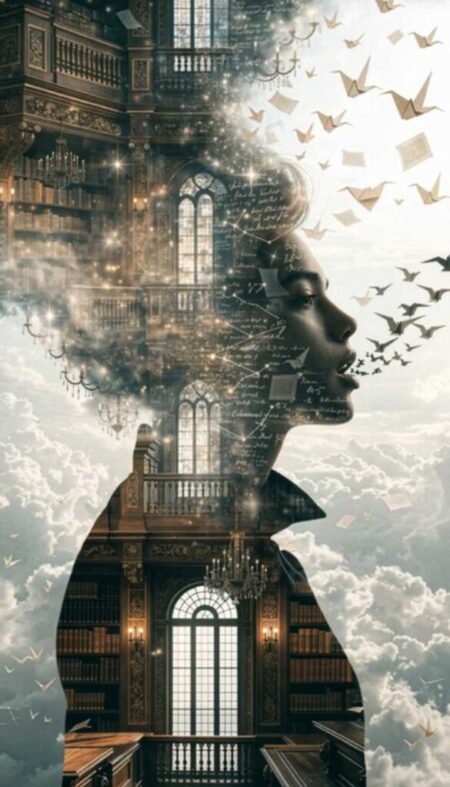
The body is organizing, receiving, responding, and living before there is a vocabulary capable of saying I am. We learned how to become somebody before
discovering what existed
before somebody appeared.
Life is intelligent before the thinker appears.
This should astonish us. Because eventually this living organism will open its eyes upon a world. Someone will give it a name. Sounds will begin acquiring meaning. Faces will become mother, father, stranger. Objects will become chair, bottle, tree, moon. Sensations will become hunger, warmth, fear, comfort.
And somewhere in this extraordinary developmental movement, a someone begins appearing. Me. The biological life was already there. The consciousness was already receiving. But the person had not yet been constructed.
There was no political identity. No religion. No profession. No nationality understood as identity. No theory of reality. No scientific worldview. No résumé. No status. No carefully defended opinion about God. No story about whether life was successful. No image to protect. And yet almost everything from which that later person will be constructed is waiting to be learned.
We arrive alive before we arrive as somebody. That distinction may be one of the most important doors into human consciousness.
How the World Enters the Child
The developing human being begins receiving distinctions. A sound is repeated. Mother. Another sound. Water. Dog. Sky. Mine. No. Words begin dividing an undifferentiated field of experience into recognizable things.
The word is not the thing itself. But once the word enters the mind, an extraordinary structure begins forming around it. Tree gathers image, texture, memory, feeling, experience, association. Mother gathers an entire emotional universe. Home gathers safety or fear, belonging or instability, smell, room, family, memory. God may gather tenderness, authority, mystery, religion, fear, Love, rejection, or nothing at all depending upon what entered the child’s world.
Words become more than labels. They become coordinates in consciousness. The child is building a story and the illusion of life based on what it can muster up, placing idenity wth the word. It becomes our library of life.
Every new experience enters somewhere within the developing architecture of knowing and not knowing. And eventually the library becomes so elaborate that the person forgets there was ever consciousness before the library. The map becomes reality.
The Birth of the Thinker
Thinking emerges within this architecture. A thought does not arrive naked. It carries language. Memory. Association. Emotion. Sensory history. Expectation. Meaning.
A single word can activate years of experience. Say father to ten people and the dictionary definition may be similar while ten completely different interior worlds appear. That tells us something profound.
We do not merely think words. We think through the accumulated energy and meaning attached to them.
Thought is transitory and composite. It appears. It moves. It changes. Another thought replaces it. Another meaning for a word is derived. A thought believed completely at fifteen may seem absurd at forty. A worldview can collapse in an afternoon.
A person can abandon a religion, discover one, change political beliefs, leave a profession, rethink a childhood, forgive a parent, or discover that an identity defended for decades was never as permanent as it seemed.
Thought changes because thought belongs to the idea of the human story. But consciousness is the field in which we become aware that thought changed.
The thinker is not necessarily the deepest thing that is alive. Thought is matter’s level, and Consciousness is the Soul’s light. Thinking emerges out of consciousness.
The thinker is what we develop for navigating this level of consciousness.
The Costume Called Self
Eventually, the developing human being has enough accumulated material to construct a remarkably convincing center. I am Mary. I am this body. This is my family. These are my beliefs. This happened to me. These are the things I like. This is what I am good at. These people approve of me. These people hurt me. This is what I want. This is who I am.
The costume has appeared. It exists at matter’s level. The mistake comes when consciousness assumes the costume is the totality of what is wearing it.
The face becomes self. Biography becomes self. Thought becomes self. And society becomes the reality in which this self must succeed. The little person is born. Not at biological birth.
The little person is born through identification. The organism arrived first. Consciousness was already present to experience. Then language, relationship, culture, memory, education, fear, desire, comparison, and social reflection gradually assembled the character. Eventually the character begins narrating everything. And because we hear the narrator constantly, we assume the narrator is who we are. We are not our thoughts; they are created light.
The human mind lives in incessant thinking, jumping from one thought to the next, mostly dreaming about the past and future. We don’t know being present because the mind is a storyteller, always talking about something or someone.
Education Enters the Library
As the narrator walks, something particularly consequential happens. The child enters human education. We should recognize what education actually is.
It is not knowledge descending from an omniscient level of reality. It is humanity transmitting what humanity has presently learned to call knowledge. This distinction matters.
It places education honestly within consciousness. Mathematics gives extraordinary consistency to relationships humanity can describe. We go back to Sumerian days in Mesopotamia and find many mathematical ideas originated then.
Science develops disciplined methods for observing patterns, testing explanations, and correcting error. It’s only observing what it can muster up as life. We only experience what we think is here, but there is more here beyond what we can think.
Celestial History transmits records and interpretations of what human beings believe happened. Language gives consciousness increasingly sophisticated ways to communicate. Medicine learns the body. Engineering learns structures. These are extraordinary achievements through a pool of consciousness, Conscious Energy, Celestial Light, and the heavenly side of living. Every one of them exists inside a larger condition: the knower remains mysterious.
The student learning biology is biological life that did not consciously construct itself. The student learning neuroscience is consciousness studying the organ through which human cognition appears. The scientist studying matter is made of matter whose ultimate existence remains an open philosophical and physical question.
Human knowledge becomes extraordinarily sophisticated while the fundamental mystery of being alive remains underneath the entire enterprise. Education therefore does not give us knowledge itself. It gives us a temporal structured inheritance of what human consciousness has been able to make intelligible at this level of thinking.
That is much more interesting.
The Human Knowledge Loop
Every scientist was once the infant without words. Every professor. Every philosopher. Every theologian. Every Nobel laureate. Before any of them became an authority, they entered the same human process.
They learned language. They learned categories. They learned what their civilization considered real. They learned mathematics from someone who had learned mathematics.
They learned scientific assumptions, methods, evidence standards, and accumulated findings from Celestial people who had learned them from others.
Then some questioned what they inherited, discovered something new, and expanded the library. This is the idea of human knowledge advancing.
But notice the enclosure: human consciousness is teaching human consciousness what human consciousness has so far been capable of knowing.
That makes the knowledge situated. We are refining a library from inside the library. And this should produce tremendous humility. Because reality is not required to end where our curriculum ends.
Knowledge Lives in Ego and satan
The problem begins when useful knowledge becomes identity. I know. Now the accumulation of information has entered the costume. Degrees become status. Expertise becomes hierarchy. Recognition becomes validation. Intelligence becomes comparison.
The human being begins deriving personal significance from the amount of the human library they can command. Knowledge that could have opened consciousness can instead reinforce the little person. This is one of ego’s most sophisticated forms because it can look like enlightenment while doing precisely what ego has always done: making somebody out of the self.
The person does not merely know mathematics. I am intelligent. The person does not merely practice medicine. I am important. The person does not merely study theology. I know God. The person does not merely investigate consciousness. I know what consciousness is. The library has become another mirror. And consciousness is staring at its reflection.
Knowing and Not Knowing
Human beings live within an extraordinary perimeter of knowing and not knowing. Inside the perimeter are things we have named, measured, classified, repeated, taught, and socially reinforced.
Outside it is an immensity. We often call what sits inside the perimeter reality. What sits outside becomes impossible, mythical, spiritual, speculative, unknown, or nonexistent.
But these words can conceal a simple fact: we do not know. Not knowing is different from nonexistence.
The microorganism existed before human beings could idealize it. Galaxies existed before we understood what galaxies were. Electromagnetic frequencies crossed the world before we built instruments capable of detecting them. Reality repeatedly preceded the human capacity to receive it.
So why would consciousness itself be different? Why would the present human bandwidth represent the total architecture of intelligence? The present level of human consciousness is a reacher that doesn’t receive everything it reaches for.
Consciousness Before the Thinker
This brings us back to the beginning. The infant was alive before the thinker became sophisticated. The organism was organized before education. Life was functioning before ideology. Something preceded the costume.
Within the ontology we are developing, that something is not merely biological machinery. Consciousness is all that is alive. Thought is one temporary apparatus through which consciousness translates a human world.
Thought belongs to this life. Consciousness belongs beyond it. The Soul is not the story thought tells about itself. The Soul is the deeper living Light from which the human experience is being received.
Then the difference between thought and consciousness becomes immense.
Thought says: I am this. Consciousness is aware of the thought. Thought says: This is reality. Consciousness can recognize that its conception of reality changing. Thought says: I know. Consciousness can stand before the unknown.
Consciousness doesn’t change as thoughts do. It’s the light all thought emerges out of
And that capacity to become aware of the limits of the thinker is one of the first places human consciousness begins opening beyond the little person’s ideas of self, reality, and God.
The Receiver
Consciousness is not generated by the personality. The personality is an interpretation based on ego and a thought system sitting in lower earthly energy. The thinker has to interpret, build, and structure what can be received.
The personality is generated within consciousness. That reverses everything. The person no longer owns consciousness. The person appears within it. The thinker doesn’t create the field. The thinker is one activity occurring inside the field.
The body becomes an instrument through which consciousness localizes a particular human experience. And the Soul becomes deeper than the temporary person can constructs for traveling through matter. We are not the creators of consciousness. We are receiving it.
A radio does not create the music merely because music becomes audible through the radio. The instrument translates. The signal exceeds the instrument.
Within the spiritual architecture of life, human consciousness is a focal point within a vastly greater field of God’s living intelligence a localization through which one particular word becomes experience.
This opens the door to the larger ontology we are reaching toward. Intelligence does not begin with humans. Intelligence does not require a biological face. The orders we call Angels, Celestial Light, Conscious Energy, and other races of intelligence belong to dimensions of God’s creation that the present human sensory and conceptual apparatus does not readily translate.
What appears empty to the senses is not necessarily empty. What appears unintelligent is not without intelligence. The newborn itself has already shown us the pattern: we can be living inside an intelligence long before we possess the consciousness to recognize what is carrying us.
We have become extraordinarily sophisticated thinkers inside of a small box of walls made to be knowing, comfortable, and conquered. We have constructed civilizations, universities, laboratories, economies, religions, technologies, and vast libraries of accumulated ideas of knowledge.
But the thinker may is standing unaware of consciousness. We learned how to describe the world before discovering what is receiving the description. We learned how to become somebody before discovering what existed before somebody appeared. We learned how to educate the person before understanding the livingness being educated.
This next movement is not the accumulation of more ideas. It is the refinement. The little person does not need another identity. Consciousness needs room beyond identity. Awareness needs kenosis/self-emptying. Because beneath the name, beneath the body, beneath education, beneath the narrator, beneath everything we have learned to call human, there remains the extraordinary light that was present at the beginning:
Something was alive before we knew what we were.
And the doorway into greater consciousness begins by asking what that something actually is. We call God by many names and with no names. Eventually, everyone finds His name.
Cliff Notes
Key Philosophical & Psychological Concepts
-
Awareness vs. Thought: Consciousness (the underlying observer or “Soul’s light”) is distinct from thoughts, which are temporary mental constructs used to navigate physical reality.
-
Pre-Personal Existence: Biological and conscious life exists long before a child acquires language, identity, or a mental persona.
-
Language as Coordinates: Words are not reality itself; they act as mental labels that group memories, associations, and emotions together to form an internal “library.”
-
The Costume of Self (Ego): Personality, titles, beliefs, and past history form a constructed identity—a “costume”—that consciousness falsely identifies as its complete self.
-
The Human Knowledge Loop: Human education and knowledge are situated within the limits of human perception, refining an internal library rather than defining ultimate reality.
-
The Receiver Model: Consciousness is not produced by the individual mind or brain; rather, the mind/body acts as a local receiver or tuner for a broader field of intelligence.
Core Knowing About Consciousness
-
Life Precedes Identity: A human organism develops cell structures, heartbeats, and sensory perception before ever learning to say “I am.”
-
The Narrator Creates the “Person”: The sense of a permanent individual (“Me”) is assembled through accumulated language, cultural conditioning, memory, and social feedback.
-
Thought is Fluctuating, Consciousness is Constant: Thoughts, beliefs, and worldviews change drastically over a lifetime, but the underlying field of awareness observing those changes remains static.
-
Knowledge Can Trap the Ego: When useful information or expertise turns into personal identity (“I am an expert”), it reinforces the ego instead of expanding awareness.
-
Reality Outpaces Perception: Unseen phenomena (like microorganisms or electromagnetic waves) existed before humans could label them; similarly, intelligence extends far beyond current human sensory limits.
Real-World Analogies: The Birth of the ‘Thinker’
-
The Radio and the Signal: Think of your physical brain and persona as a radio set, and consciousness as the broadcast signal. The radio doesn’t originate the music; it simply translates the signal into audible sound. Mistaking the personality for the source of consciousness is like assuming the radio box composed the song.
-
The Actor and the Costume: Before taking a role, an actor exists independently on stage. Over time, they put on a costume, learn a script, and adopt a character name. The “thinker” is the character being acted out, while consciousness is the actor beneath the costume who eventually forgets they are playing a part.
-
The Map vs. The Territory: Language and mental concepts act as a GPS map to help navigate a city (the physical world). The “thinker” is formed when a person spends so much time staring at the screen that they mistake the digital lines on the map for the actual roads and trees around them.