
Human Education
We’re memorizing life into costumes and roles
into a reality that suits them.
Human education was shaped by humans placing a measure on intelligence. We carried ideas and found subtance to grow for what could live as knowing and not knowing. There was a claim for life to live in knowing more than in not knowing.
Human education is shaping our thought system by teaching it what is permitted to be counted as real. It is a system built on memorization, measurement, and repetition, learning what has already been placed by others and being called knowledge. In doing so, it trains the participant to operate within a narrow band of reality while mistaking that band for the Truth.
We can only see what we think is here, but there is more here than what we can think. Perception does not reveal totality; it reveals correspondence. We notice what our interior structure is prepared to interpret.
We do not see the whole of anything. We see the portion our consciousness can carry.
The mind filters reality through its current vocabulary of thought and feeling. If a concept does not exist within us, we pass by its presence without recognition. If an experience exceeds our emotional range, we reduce it to something manageable. In this way, intelligence becomes not the expansion of awareness, but the reinforcement of what is already familiar.
We’re standing in narrow hallways, making our knowing and not knowing fit ego and satan. The mind’s awareness is the narrator’s woven cloth of unawareness.
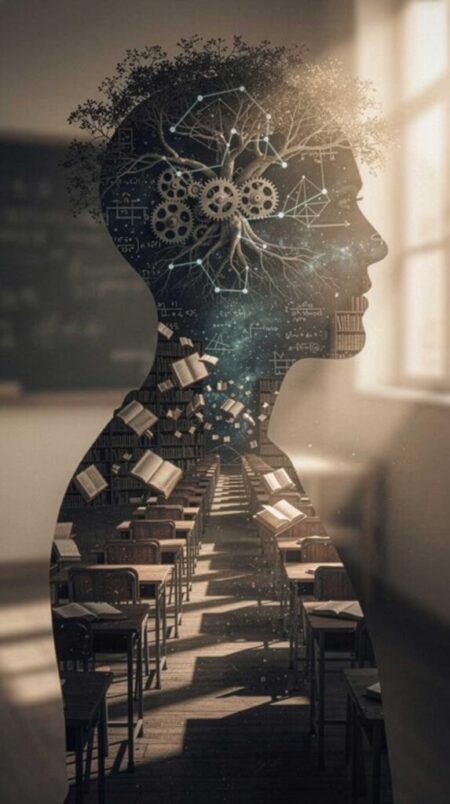
The self-chattering mind lives in incessant thinking, jumping from one thought to the next. It doesn’t know the enormity of Soul intelligence within.
Education often trains us to accumulate information, to memorize established conclusions, to repeat what has been validated by others. This produces measurable ideas but not necessarily expanded sight. We may learn the language of reality without deepening our participation in it.
There is always more here than we can think. Reality exceeds our categories. Consciousness precedes our interpretation of it. The unseen is not absent it is simply beyond the bandwidth of our current thought-forms.
We do not fail to see because nothing is present. We fail to see because we cannot yet carry it.True intelligence is not the quantity of information retained. It is the widening of perception, the ability to experience what once lay beyond our interior reach. And that widening does not come through memorization. It comes through depth, substance, and maturity.
The idea that reality exists as a single, face-value slice is itself the illusion. What we call “mainstream reality” is not totality; it is the portion of experience our current consciousness can stabilize. Nothing in consciousness begins from itself. Human awareness is not self-generated; it is woven from a greater Intelligence. We did not invent perception. We inherited it.
Yet we interpret humanity according to the mind’s present bandwidth. What we call “a person” is already a conceptual reduction. We see the body and call it self, while ignoring the trillions of microorganisms living upon and within it. We recognize the visible organism but not the ecosystem. Even at the biological level, we mistake complexity for singular identity.
We do not see the whole. We see what our thinking can frame. Education, as society structures it, does not teach the nature of reality. It teaches how to operate within a stabilized version of it. It trains functionality, not transcendence. It rewards memorization, repetition, and compliance with accepted models of explanation.
Titles, credentials, professions, these become garments the individual learns to wear. Identity is constructed in matter, reinforced by recognition and hierarchy. The mind is affirmed for staying within these boundaries, for mastering the rules of the visible slice.
But functioning inside a system is not the same as understanding existence. To navigate reality is not to comprehend it. True intelligence would ask: What is consciousness? What precedes matter? What is the origin of perception itself? We would find ourselves diving deeper into Creation and other races of intelligence, shaping the idea of reality and human photosynthesis.
Instead, we are taught how to perform well within a frame that assumes its own completeness. Mainly out of very few human beings in the history of the human race making it to God. Society is the illusion. Only one of us is here with God. Life is higher intelligence with every piece living in another light beyond how we perceive it.
The mainstream level lives very real, but is an illusion. And nothing in consciousness is whole at the level it appears. The cardiologist, neurologist, scientist, accountant, and teacher all pass through the same factory of orientation. They learn how to see, what to value, and which questions are acceptable. They master fragments of the world while never being shown the larger field in which those fragments exist. No one is invited to climb the walls of the system; they are taught to decorate the room.
This form of learning strengthens the mind but leaves the Soul untouched. We carry more with us, but very few ever walk beyond the walls of mainstream reality to extend the Soul. No one is learning about Spirit firsthand or experiencing God to know another existence of their livingness.
The Soul carries a deeper well of intelligence than the mind. The mind organizes what has already been agreed upon; the Soul knows differently. The mind builds certainty from repetition; the Soul responds to depth. What the mind memorizes becomes thought mazes in our thought system that are continually walked.
Depth does not arrive through instruction. It arrives through encounter through the offbeat moment, the disruption, the enigma that pulls us outside comfort and beyond inherited meaning. These moments cannot be studied in advance. They must be lived. And when they are, substance forms. This is where consciousness expands. Not by accumulating information, but by being stretched beyond identity. Not by learning about reality, but by standing inside it without explanation.
Human education builds a self. Encounter dissolves one.
The idea of self is placed with self-identity in matter, shaping the “ideal someone” we want to be. We make the body self because human consciousness has not lived enlightened to know the other side of our existence. No one considers conscious energy or who is thinking and where the thought is coming from. There is a much bigger pool of intelligence beyond what can work for us, live, and be tangibly explained at face value. We live for what works for us, rather than what we can live with, knowing through more layers of living.
Consciousness is coming into us from outside of us.
The body living as self begins solely by witnessing our idea of other people’s opinions of us. When we see their reactions to seeing us as good, we build upon it. We don’t learn to know Spirit over the body as self. We lose depth and substance for a deeper understanding of what human are and aren’t.
What we miss, when we remain inside the educational frame alone, is the divine light already present within us, the greater intelligence doing the thinking itself. We mistake the narrator for the source. We identify with the costume and forget the one wearing it.
Reality, as lived, is singular. Only one of us is here with God at any moment, we’re living through a narrative that only they can filter, interpret, and realize. The world does not exist outside this lived perspective. History, society, and meaning appear within it.
Education teaches us what to think. The Soul reveals who is thinking.
And until that shift occurs, we continue to build identities in matter while overlooking the deeper truth of our existence: that consciousness itself is the ground of life, and God is nearer than any role we learn to play.
The Illusion of Many vs. the Reality of One
Society trains us to believe that mainstream ideas are life, that we possess a self, that we are our thoughts, and that the world we see is reality itself. These assumptions are rarely questioned; they are inherited, reinforced, and lived as fact.
Yet what we call life is already filtered long before we become aware of it. The self is constructed, thought is narrated, and the world that appears is shaped by the level of consciousness doing the seeing. What feels obvious is often only familiar.
The contemplative path begins when these assumptions loosen, and we sense that something deeper is living with us, something prior to thought, prior to identity, and more real than the surface of the world we have been taught to accept.
We speak as if consciousness is distributed evenly across bodies, as if the world exists independently, and we simply enter it as one observer among billions. But lived reality does not function that way. The observer is the only one in the light.
Human experience is singular. Only one consciousness is ever being lived at a time, and it is always this one. The world that appears is the world appearing to the individual who is present. Everything else, people, history, institutions, even God as a concept, arises within that field of awareness. Only in the moment that we hear God’s voice do we live with another presence beyond ours. Until then, the narrator hears what the narrator wants to hear and doesn’t want to hear. We see what we want to see and don’t want to see.
The individual is the one walking through a story, placing depth, substance, and maturity in life. Reality is not accessed collectively. It is lived locally. Each individual carries the whole of existence as it can be known to them at their level of consciousness. The many are encountered as figures within experience; life is placed to live real, but it is the only illusion existing at the observer’s level of consciousness.
Education reinforces the illusion of many by externalizing meaning. It teaches us to orient toward consensus, authority, and shared agreement, rather than toward direct knowing. In doing so, it pulls attention outward and fragments experience into roles, comparisons, and identities. We become one among many instead of the one who is living.
Consciousness is a single vantage, one narrative stream through which the world becomes real. History, society, and even the idea of humanity itself live inside that stream. When the body dissolves, the entire world as it was known dissolves with it.
This is why reality feels total. Why suffering, love, fear, and insight are never partial. They are not shared experiences; they are complete experiences happening once.
God is not distributed across the many. God is encountered in the one. God is not one observer among many. God is the witnessing intelligence in which all observers arise.
Human consciousness does not witness God. God witnesses human consciousness. Every thought, perception, life, and world unfolds within His awareness.
This is why God is closer than thought and farther than distance. He does not compete with the observer; He contains it. The individual does not stand apart from God, but lives as a localized participation in His knowing.
There is always only one true Witness.
What changes is not God’s presence, but the depth through which consciousness is willing to be seen.
The illusion of many keeps us focused on identity, comparison, and position. The reality of one returns us to responsibility, depth, and presence. Not “What should people believe?” but “What is being lived here?”
When this is seen, the question of reality shifts. We stop asking how the world works and begin asking who is living it. And in that turning, consciousness begins to recognize itself not as an object among others, but as the ground through which everything appears.
The many belong to the story. The one belongs to life.
And depth begins where the illusion loosens.